Notfall
Safety & emergenciesCommunicating in an emergency in Germany: calling for help, giving your location, describing what happened, and following dispatcher instructions. Emergency language must be short, clear, and calm — the priority is getting help, not perfect grammar.
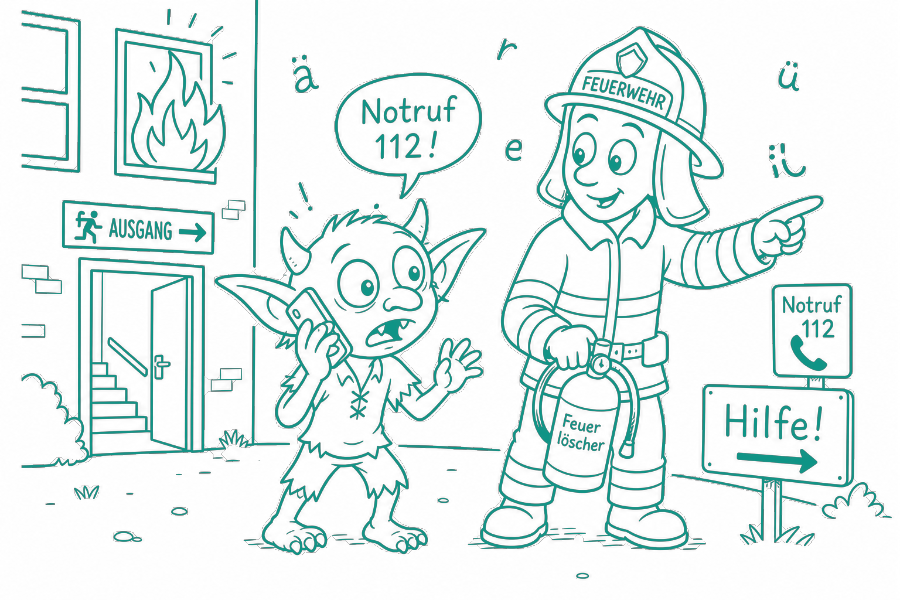
Vocabulary
Sentence Structure
Lead with Hilfe! — then your location. Grammar is secondary.
Es ist + what happened — three words the dispatcher needs immediately.
Useful Phrases
- Hilfe!
- Ich brauche einen Krankenwagen!
- Bitte kommen Sie schnell!
- Es ist ein Notfall.
- Ich bin in der [Straße] Nummer [Zahl].
- Ich bin am Bahnhof.
- Ich bin in der Nähe von …
Notruf, wo ist der Notfall?
Emergency, where is the emergency?
Hilfe! Ich bin in der Hauptstraße 5.
Help! I am at Hauptstraße 5.
Was ist passiert?
What happened?
Ein Mann ist gefallen. Er hat Schmerzen.
A man has fallen. He is in pain.
Ist er wach?
Is he awake?
Ja, er ist wach.
Yes, he is awake.
Gut. Der Krankenwagen kommt. Bleiben Sie bitte bei ihm.
Good. The ambulance is coming. Please stay with him.
Okay. Danke.
Okay. Thank you.
112 = Feuerwehr & Rettungswagen | 110 = Polizei
112 = fire & ambulance | 110 = police
Meine Adresse: [Straße, Hausnummer, Ort]
My address: [street, number, city]
Mein Name: [Vorname Nachname]
My name: [first last]
Allergie: [z.B. Penicillin] / keine
Allergy: [e.g. penicillin] / none
Kontaktperson: [Name] Tel: [Nummer]
Contact person: [name] Tel: [number]
Sentence Structure
Perfekt to describe what just happened: ist (P2) · gestürzt (END).
Current condition: sein + adjective.
Useful Phrases
- Eine Person ist gestürzt.
- Es hat einen Unfall gegeben.
- Jemand ist verletzt.
- Es gibt eine Blutung.
- Er / Sie ist bewusstlos.
- Er / Sie atmet nicht.
- Er / Sie blutet stark.
- Er / Sie ist ansprechbar.
Notruf, was ist passiert?
Emergency services, what has happened?
Hilfe! Eine ältere Frau ist auf dem Gehweg gestürzt. Sie ist bewusstlos!
Help! An elderly woman has fallen on the pavement. She is unconscious!
Wo sind Sie genau?
Where are you exactly?
Ich bin in der Goethestraße 7, in der Nähe vom Supermarkt.
I am at Goethestraße 7, near the supermarket.
Wir schicken sofort einen Krankenwagen. Bleiben Sie bei der Person.
We are sending an ambulance immediately. Stay with the person.
Sentence Structure
Perfekt to report what you've already done — important for the dispatcher.
Contrasting two conditions with aber.
Useful Phrases
- Ich habe schon die 112 angerufen.
- Ich habe ihn in die stabile Seitenlage gebracht.
- Ich habe mit der Herzmassage angefangen.
- Ich halte die Wunde zusammen.
- Er ist bei Bewusstsein / bewusstlos.
- Er atmet / atmet nicht.
- Er hat einen Puls / keinen Puls.
- Die Verletzung ist am Kopf / am Bein.
Notruf 112, was ist passiert?
Emergency 112, what has happened?
Ein Mann am U-Bahnhof Mitte hat Atemnot. Er ist etwa 60 Jahre alt.
A man at U-Bahnhof Mitte is having breathing difficulties. He is about 60 years old.
Ist er noch bei Bewusstsein?
Is he still conscious?
Ja, er ist wach, aber er kann kaum sprechen. Er hält sich die Brust.
Yes, he is awake, but he can barely speak. He is holding his chest.
Gut. Lassen Sie ihn hinsetzen und lockern Sie enge Kleidung. Der Notarzt kommt.
Good. Have him sit down and loosen any tight clothing. The emergency doctor is coming.
Okay. Ich bleibe bei ihm und warte auf den Krankenwagen.
Okay. I'll stay with him and wait for the ambulance.
Sehr geehrte Damen und Herren,
Dear Sir or Madam,
ich melde mich heute krank, weil ich bei einem Unfall am Bahnhof leicht verletzt wurde.
I am calling in sick today because I was slightly injured in an accident at the train station.
Ich war als erste Hilfsperson tätig und habe auf den Rettungswagen gewartet. Der Arzt hat mir heute Pause empfohlen.
I acted as first aider and waited for the ambulance. The doctor has recommended rest today.
Könnten Sie mir bitte mitteilen, ob ich ein ärztliches Attest einreichen soll?
Could you please let me know whether I should submit a medical certificate?
Mit freundlichen Grüßen Klaus Berger
Kind regards, Klaus Berger
- States reason with weil (verb at end)
- Clear factual account — Perfekt used correctly
- Polite request with Könnten Sie…
- ob + verb at end (indirect question)
Sentence Structure
Lead with the most critical information, then add qualifications.
Precise vital sign description — two adjectives with und.
Useful Phrases
- Die Person ist bewusstlos und reagiert nicht auf Ansprache.
- Die Atmung ist flach und unregelmäßig.
- Der Puls ist kaum noch tastbar.
- Es gibt eine stark blutende Wunde am Kopf.
- Verstanden, ich beginne mit der Herzmassage.
- Wie viele Drücke pro Minute soll ich machen?
- Soll ich ihn in die stabile Seitenlage bringen?
- Er reagiert — ich glaube, er kommt zu sich.
Notruf, was ist der Notfall?
Emergency services, what is the emergency?
Ein Mann, etwa 50 Jahre alt, ist auf der Straße plötzlich zusammengebrochen und reagiert nicht mehr.
A man, about 50 years old, suddenly collapsed on the street and is no longer responding.
Atmet er noch?
Is he still breathing?
Nein, ich kann keine Atemgeräusche feststellen. Der Puls ist sehr schwach.
No, I cannot detect any breathing sounds. The pulse is very weak.
Beginnen Sie sofort mit der Herzmassage. 30 Drücke, dann zweimal beatmen. Ich leite Sie an.
Start chest compressions immediately. 30 compressions, then two rescue breaths. I will guide you.
Verstanden. Ich mache es. Wann kommt der Notarzt?
Understood. I'm doing it. When is the emergency doctor arriving?
Sehr geehrte Damen und Herren,
Dear Sir or Madam,
ich war am 3. Juli gegen 14 Uhr Zeuge eines Verkehrsunfalls in der Goethestraße und möchte hiermit meinen Bericht abgeben.
On 3 July at around 2 pm I witnessed a traffic accident in Goethestraße and would like to submit my account.
Ich beobachtete, wie ein dunkelblaues Fahrzeug die rote Ampel überquerte und einen Radfahrer touchierte. Der Radfahrer stürzte, war jedoch ansprechbar. Ich habe sofort die 112 alarmiert und bis zum Eintreffen des Rettungswagens Erste Hilfe geleistet.
I observed how a dark blue vehicle ran a red light and clipped a cyclist. The cyclist fell but was conscious. I immediately called 112 and gave first aid until the ambulance arrived.
Ich stehe gerne als Zeugin zur Verfügung, falls Sie weitere Auskünfte benötigen.
I am happy to act as a witness should you need further information.
Mit freundlichen Grüßen Sandra Hoffmann
Kind regards, Sandra Hoffmann
- Precise time/place opener — journalistic style
- Indirect speech: "Ich beobachtete, wie …" (verb at end)
- Perfekt for completed actions (habe alarmiert, geleistet)
- Offers availability as witness
- Formal register throughout
Progression
| Level | I can… | Example |
|---|---|---|
| A1 | Call for help and give your location. | Hilfe! Ich bin in der Bahnhofstraße 12. Es ist ein Unfall. |
| A2 | Describe what happened and the condition of the injured person. | Eine Frau ist gestürzt. Sie ist bewusstlos. Bitte kommen Sie schnell! |
| B1 | Give precise details, answer the dispatcher's questions, and follow instructions. | Er atmet nicht. Ich habe schon mit der Herzmassage angefangen. |
| B2 | Give a full account of the situation including vital signs and history. | Die Person ist bewusstlos, atmet aber noch. Der Puls ist schwach und unregelmäßig. |
Your milestones
- A1I can shout for help and say where I am.
- A2I can describe what happened and the injured person's condition.
- B1I can answer a dispatcher's questions and follow instructions.