Zahnarzt
Survival & daily lifeGoing to the dentist in Germany: booking a Termin, describing toothache and where it hurts, understanding what the Zahnarzt wants to do, and — at higher levels — discussing costs, Zuzahlung, and what your Krankenkasse covers.
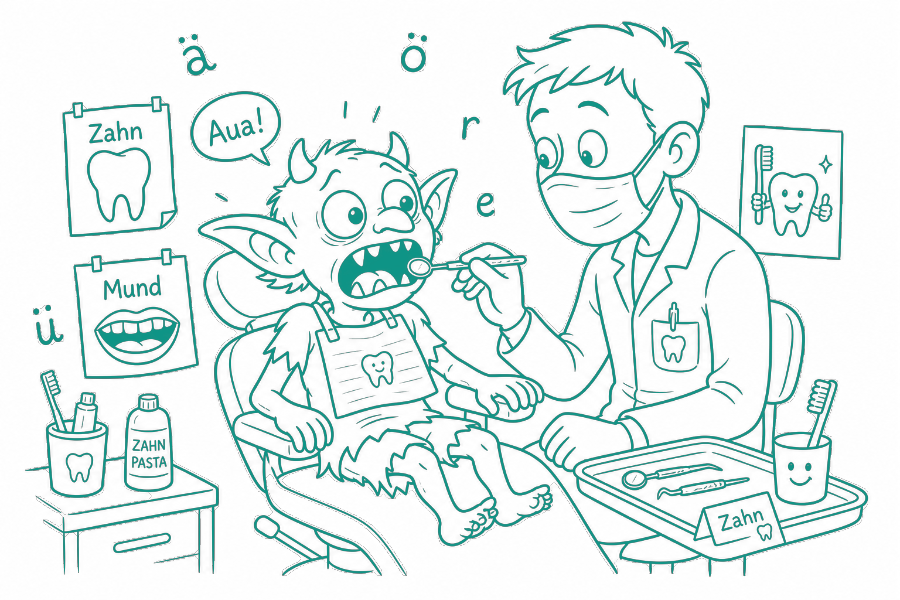
Vocabulary
Sentence Structure
haben + Zahnschmerzen — the sentence that gets you the appointment.
Useful Phrases
- Ich habe Zahnschmerzen.
- Ich brauche einen Termin.
- Es ist dringend.
- Der Zahn tut sehr weh.
Zahnarztpraxis Dr. Lang, guten Tag.
Dr. Lang’s dental practice, good day.
Guten Tag. Ich habe starke Zahnschmerzen. Ich brauche einen Termin.
Good day. I have bad toothache. I need an appointment.
Können Sie heute um 14 Uhr kommen?
Can you come today at 2 pm?
Ja, sehr gern. Danke!
Yes, gladly. Thank you!
Zahnarzt Dr. Lang: heute 14 Uhr. Mitbringen: Versichertenkarte. Zahn hinten links!
Dentist Dr. Lang: today 2 pm. Bring: insurance card. Tooth back left!
Sentence Structure
weh tun is separable — the position words (hinten/oben/links) go in the middle.
Useful Phrases
- Der Schmerz ist hier — hinten oben rechts.
- Es tut weh, wenn ich etwas Kaltes trinke.
- Der Zahn ist seit drei Tagen empfindlich.
- Muss der Zahn gebohrt werden?
Machen Sie bitte den Mund auf. Wo genau tut es weh?
Please open your mouth. Where exactly does it hurt?
Hier hinten oben. Besonders bei kaltem Wasser.
Here at the back on top. Especially with cold water.
Ich sehe ein kleines Loch. Wir machen eine Füllung — mit Betäubung.
I see a small cavity. We’ll do a filling — with anaesthetic.
Tut die Spritze weh?
Does the injection hurt?
Nur ganz kurz. Danach merken Sie nichts mehr.
Only very briefly. After that you won’t feel anything.
Sentence Structure
werden in the Perfekt — describing a change: it has become sensitive.
Useful Phrases
- Das Zahnfleisch ist entzündet und blutet.
- Ich habe eine Schwellung an der Wange.
- Der Schmerz ist pochend und kommt in Wellen.
- Muss der Zahn gezogen werden, oder geht eine Wurzelbehandlung?
- Wann sollte ich zur nächsten Kontrolle kommen?
Der Zahn ist tief entzündet. Eine normale Füllung reicht leider nicht mehr.
The tooth is deeply inflamed. A normal filling unfortunately isn’t enough anymore.
Heißt das, der Zahn muss gezogen werden?
Does that mean the tooth has to be pulled?
Nicht unbedingt. Wir können eine Wurzelbehandlung versuchen und den Zahn erhalten.
Not necessarily. We can try a root canal and save the tooth.
Das wäre mir lieber. Wie viele Termine brauche ich dafür?
I’d prefer that. How many appointments do I need for it?
Meistens zwei. Heute reinige ich die Wurzel, beim nächsten Mal wird sie gefüllt.
Usually two. Today I clean the root, next time it gets filled.
Sehr geehrtes Praxisteam,
Dear practice team,
seit zwei Tagen habe ich Schmerzen an einem hinteren Backenzahn, und eine alte Füllung fühlt sich locker an.
for two days I’ve had pain in a back molar, and an old filling feels loose.
Könnten Sie mir kurzfristig einen Termin anbieten? Vormittags bin ich flexibel.
Could you offer me an appointment at short notice? I’m flexible in the mornings.
Mit freundlichen Grüßen Anna Becker
Kind regards, Anna Becker
- How long and what kind of pain
- Any concrete detail (loose filling)
- Offer flexibility for a quicker slot
Sentence Structure
Asking about cost — Eigenanteil is the word that matters at the German dentist.
Useful Phrases
- Können Sie mir einen Heil- und Kostenplan erstellen?
- Was übernimmt die gesetzliche Kasse, und was zahle ich selbst?
- Gibt es eine günstigere Alternative zum Implantat?
- Ich möchte den Kostenvoranschlag erst mit meiner Zusatzversicherung klären.
- Rechnet sich die professionelle Zahnreinigung für mich?
Der Zahn lässt sich nicht mehr erhalten. Ich würde ein Implantat empfehlen.
The tooth can’t be saved anymore. I’d recommend an implant.
Das klingt teuer. Wie hoch wäre mein Eigenanteil ungefähr?
That sounds expensive. Roughly how high would my out-of-pocket share be?
Bei einem Implantat trägt die Kasse nur wenig — Sie müssten mit etwa 1.800 Euro rechnen.
For an implant the insurer covers only a little — you’d have to reckon with about 1,800 euros.
Gibt es eine Alternative, die die Kasse besser bezuschusst?
Is there an alternative that the insurer subsidises better?
Eine Brücke. Ich erstelle Ihnen für beide einen Heil- und Kostenplan, dann können Sie vergleichen.
A bridge. I’ll draw up a treatment-and-cost plan for both, then you can compare.
Sehr geehrte Damen und Herren,
Dear Sir or Madam,
mein Zahnarzt hat mir einen Heil- und Kostenplan für eine Krone erstellt, den ich Ihnen im Anhang zusenden.
my dentist has drawn up a treatment-and-cost plan for a crown, which I am sending you attached.
Könnten Sie mir mitteilen, welchen Festzuschuss Sie übernehmen und wie hoch mein Eigenanteil voraussichtlich ausfällt?
Could you tell me what fixed subsidy you cover and how high my out-of-pocket share is likely to be?
Mit freundlichen Grüßen Anna Becker
Kind regards, Anna Becker
- Reference the Heil- und Kostenplan and attach it
- Ask the two precise numbers: Festzuschuss and Eigenanteil
- Do this BEFORE treatment — approval must come first
Progression
| Level | I can… | Example |
|---|---|---|
| A1 | Book an appointment and say a tooth hurts. | Ich habe Zahnschmerzen. Ich brauche einen Termin. |
| A2 | Say which tooth hurts and understand the basic treatment. | Der Zahn hinten oben tut weh. |
| B1 | Describe symptoms precisely and ask what the treatment involves. | Der Zahn ist empfindlich auf Kälte — muss er gezogen werden? |
| B2 | Discuss the cost plan, your Eigenanteil, and what the Kasse covers. | Wie hoch ist mein Eigenanteil bei einer Krone? |
Your milestones
- A1I can book a dental appointment and say a tooth hurts.
- A2I can point to the right tooth and follow the basic treatment.
- B1I can describe the symptom precisely and ask about the procedure.
- B2I can understand the Heil- und Kostenplan and my Eigenanteil.