Wetter
Survival & daily lifeTalking about the weather in German: naming what you see out the window, checking the Wettervorhersage before you leave the house, and — at higher levels — using weather as the small-talk opener that keeps a German conversation going.
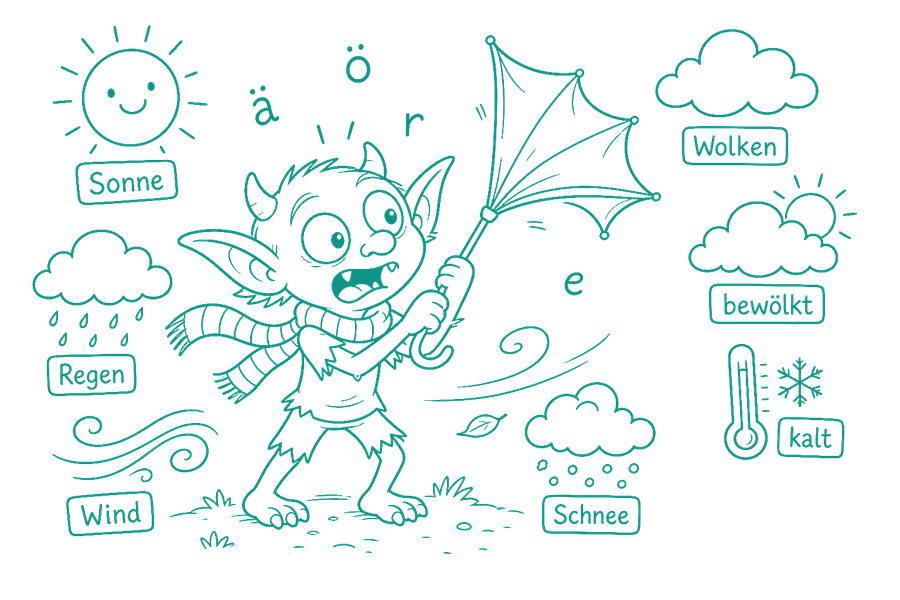
Vocabulary
Sentence Structure
Subject-verb — the simplest possible weather sentence.
es ist + adjective — the dummy subject es for weather.
Useful Phrases
- Die Sonne scheint.
- Es ist kalt / warm.
- Wie ist das Wetter heute?
- Es ist schön draußen!
Guten Morgen! Wie ist das Wetter heute?
Good morning! How’s the weather today?
Die Sonne scheint, aber es ist noch kalt.
The sun is shining, but it’s still cold.
Gut, dann nehme ich eine Jacke mit.
Good, then I’ll bring a jacket.
Heute: Sonne, kalt. Jacke und Schal mitnehmen!
Today: sun, cold. Bring jacket and scarf!
Sentence Structure
Impersonal es regnet — no real subject, just the weather happening.
Useful Phrases
- Es ist bewölkt, aber es regnet nicht.
- Heute sind es 15 Grad.
- Es soll morgen schneien.
- Nimm einen Schirm mit, es regnet!
Weißt du, wie das Wetter morgen wird?
Do you know what the weather will be like tomorrow?
Ich habe gelesen, es wird bewölkt und windig — etwa 12 Grad.
I read that it’ll be cloudy and windy — about 12 degrees.
Dann nehme ich lieber eine warme Jacke mit.
Then I’d better bring a warm jacket.
Sentence Structure
laut + Dativ cites the source; sich abkühlen is separable & reflexive.
Useful Phrases
- Laut der Vorhersage gibt es später ein Gewitter.
- Es soll den ganzen Tag regnen.
- Es klart gegen Nachmittag auf.
- Sei vorsichtig, es soll heute Abend blitzen und donnern.
- Die Temperaturen fallen in der Nacht unter null.
Sollen wir das Picknick wirklich heute machen? Ich habe gehört, es soll ein Gewitter geben.
Should we really do the picnic today? I heard there’s supposed to be a thunderstorm.
Laut der Vorhersage kommt das erst am Abend. Bis dahin sollten wir fertig sein.
According to the forecast that’s only coming in the evening. We should be done by then.
Na gut, aber ich nehme trotzdem eine Jacke mit, falls es sich abkühlt.
All right, but I’ll bring a jacket anyway in case it cools down.
Sentence Structure
jemandem aufs Gemüt schlagen — a fully idiomatic way to say weather affects your mood.
Useful Phrases
- Was für ein Wetter heute, was?
- Kaum zu glauben, dass es letzte Woche noch so kalt war.
- Dieses Wetter schlägt mir echt aufs Gemüt.
- Man merkt den Klimawandel schon an den Sommern hier.
- Sind Sie auf den Regen morgen gefasst?
Was für ein Wetter heute, was? Erst Sonne, jetzt schon wieder Regen.
What weather today, huh? First sun, now rain again already.
Ja, total unberechenbar. Letzte Woche war es noch richtig warm.
Yeah, totally unpredictable. Last week it was still really warm.
Ich glaube, das Wetter schlägt langsam allen aufs Gemüt.
I think the weather is starting to weigh on everyone’s mood.
Da sind Sie nicht allein — ich freue mich schon auf den Sommer.
You’re not alone there — I’m already looking forward to summer.
Progression
| Level | I can… | Example |
|---|---|---|
| A1 | Say what the weather is like today. | Die Sonne scheint. Es ist warm. |
| A2 | Describe changing weather and give a temperature. | Es ist bewölkt und es regnet ein bisschen. |
| B1 | Understand a forecast and react to it appropriately. | Laut der Vorhersage kühlt es sich am Abend ab. |
| B2 | Use weather as small talk and comment on how it affects mood. | Dieses graue Wetter schlägt mir wirklich aufs Gemüt. |
Your milestones
- A1I can name basic weather and say if it's warm or cold.
- A2I can describe the weather and give a temperature.
- B1I can follow a forecast and warn someone about it.
- B2I can use weather naturally as small talk.